Quick answer
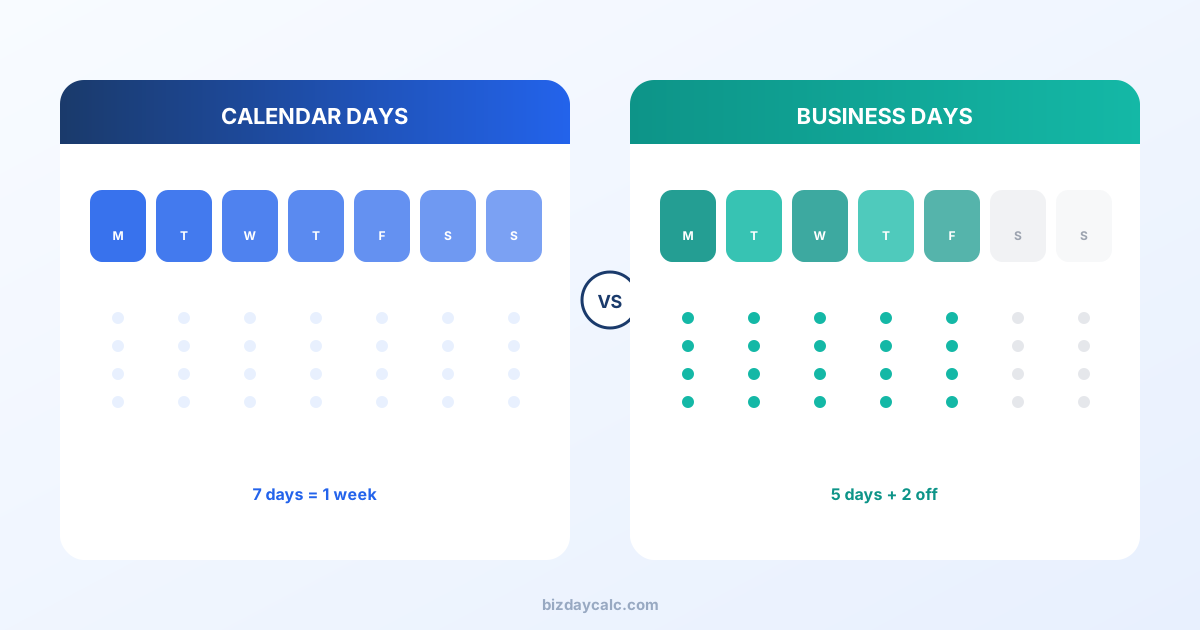
Calendar days include every day, including Saturdays and Sundays. Business days usually mean working weekdays, Monday to Friday, and often exclude public holidays. If a deadline says 10 calendar days, count every day. If it says 10 business days, skip weekends and check whether holidays and the start date are excluded.
Key takeaways
- Calendar days include weekends.
- Business days usually exclude weekends and may exclude public holidays.
- Most "from today" business-day calculations start counting on the next working day.
- Need an exact date? Use a calculator instead of counting by hand.
Need the exact date?
For common deadlines, open a quick calculator instead of manually counting weekdays:
Calendar days count every day
Calendar days include every date on the calendar: weekdays, weekends, and public holidays. If something takes 7 calendar days from Monday, you count Tuesday, Wednesday, Thursday, Friday, Saturday, Sunday, and Monday.
Business days usually count working weekdays
Business days normally mean Monday to Friday, excluding weekends. In many situations, public holidays are also excluded because offices, banks, or support teams may be closed.
Why it matters
The difference can be significant. Ten calendar days is always ten days. Ten business days can stretch across two full weeks, and longer if public holidays are involved.
- Shipping estimates often use business days
- Customer service SLAs may use business days
- Finance and banking processes often use business days
- Regulated complaint deadlines may use working days or calendar days depending on the rule
Business days vs calendar days comparison
| Term | What it usually counts | Simple example |
|---|---|---|
| Calendar days | Every day, including weekends and holidays. | 5 calendar days from Monday reaches Saturday if the start day is not counted. |
| Business days | Working weekdays, usually Monday to Friday. | 5 business days from Monday usually reaches the following Monday if the start day is not counted. |
| Working days | Often the same as business days, but always check the policy wording. | A customer service SLA may pause at weekends and public holidays. |
Does calendar days include weekends?
Yes. Calendar days include weekends. If wording says calendar days, count Saturdays and Sundays unless the contract, policy or law says otherwise.
Does 5 business days include today?
Usually no. Most "from today" business-day calculations begin on the next working day, then skip weekends and any public holidays selected for the country or policy.
10 business days vs 10 calendar days
Ten calendar days is always ten days on the calendar. Ten business days usually takes about two working weeks and can take longer if a public holiday falls inside the period.
When should you use business days?
Use business days for workplace deadlines, banking, customer support response times, delivery estimates and processes that only move during normal working weekdays.
Business days vs calendar days in law and contracts
The exact meaning of “business day” or “calendar day” usually comes from the specific contract, policy or law that sets the deadline, not from a universal dictionary. Some rules say “working days”, some say “clear days”, and some count from the day after the event rather than the day itself. When a deadline matters, read the wording closely and confirm whether weekends and public holidays are excluded.
“Working days” vs “business days” vs “clear days”
These three phrases overlap but are not identical. “Business days” and “working days” usually both mean Monday to Friday, excluding public holidays where stated. “Clear days” is a stricter legal term that often excludes both the day the notice is given and the day of the deadline itself. When a statute or contract uses “clear days”, the resulting date can be two or more days later than a plain working-day count.
Worked example: 10 business days in August 2026
Suppose a contract signed on Monday 3 August 2026 allows “10 business days” for a response. Counting only weekdays and excluding the UK summer bank holiday on Monday 31 August would push the deadline well beyond ten calendar days. If the start day is not counted, the tenth business day falls around Monday 17 August — about two full calendar weeks later. If a bank holiday falls inside the window, it stretches further.
This is why “10 business days” and “10 calendar days” almost never produce the same date, and why a calculator that knows the correct holiday calendar is safer than counting by hand.
Where each term is most common
- Delivery and courier estimates: usually business days.
- Banking, payments and clearing: business days.
- Regulated complaint and FOI deadlines: often working days, with a defined start.
- Cooling-off periods and consumer rights: usually calendar days.
- Notice periods: depends on the contract or statute.
Common mistakes
The most common mistakes are counting the start day when you should not, forgetting a bank holiday, and treating “working days” and “business days” as different when the policy treats them the same. If two people read the same deadline differently, the safest fix is to confirm the interpretation in writing and use a date calculator for the arithmetic.
Related calculators
- Business Day Calculator - calculate working days between two dates.
- 5 business days from today - answer a common deadline question quickly.
- 7 business days from today - check a popular shipping, admin, or support timeline.
- 10 business days from today - compare a two-week working-day window.
- Next business day calculator - find the next working day.
Useful official resources
These sources are directly relevant to the date, public holiday, delivery, SLA, or complaint-handling topic covered in this article.
Related video searches
If you prefer a video explanation, these searches can help you find relevant explainers on YouTube.
Use bizdaycalc to compare date ranges without counting by hand.
Loading comments...