You send a contract to a client on a Thursday, with a · “response within 5 business days · ” clause. The following Monday is a bank holiday. Does the deadline move to Wednesday or Thursday? The answer depends on whether the contract wording treats bank holidays as business days — and in most UK contexts, they are not.
Key takeaways
- Bank holidays commonly extend working-day deadlines by one or more days.
- England & Wales, Scotland, and Northern Ireland each have different bank holiday dates.
- Ireland and the United States use separate public holiday calendars entirely.
- Always check the specific contract, SLA, or policy wording — not all organisations treat bank holidays the same way.
Usually, no
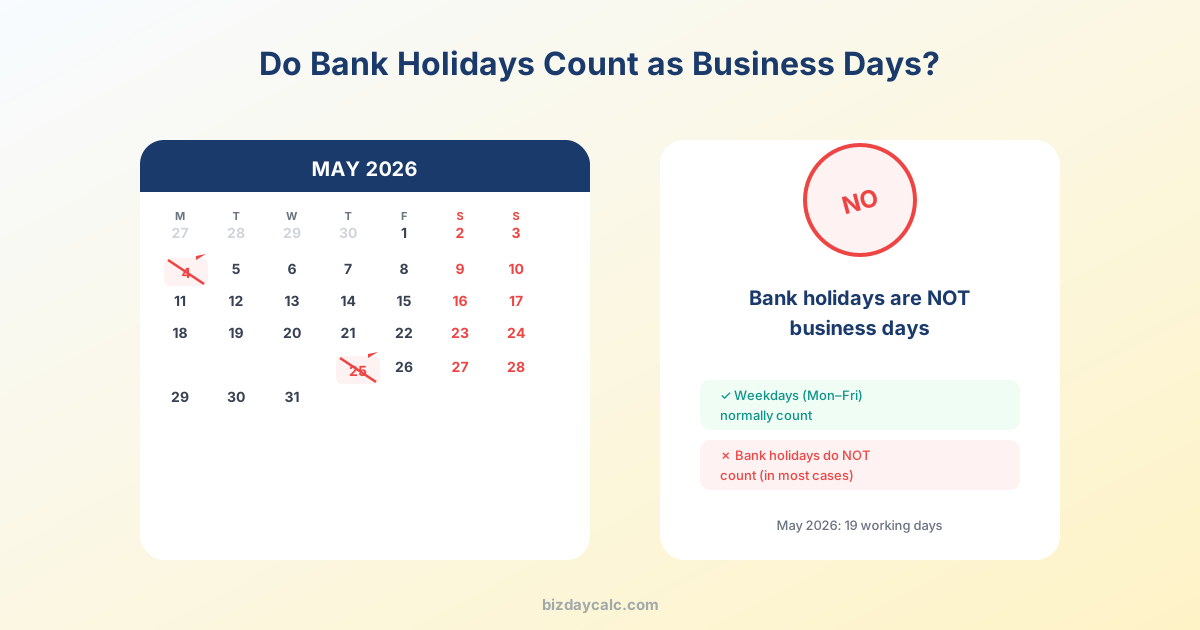
Bank holidays and public holidays usually do not count as business days where the organisation is closed. This is especially common for banks, public services, delivery estimates, and formal response deadlines.
But check the wording
Some companies use business days to mean weekdays only, while others explicitly exclude public holidays. If a policy says 'working days excluding public holidays', then bank holidays should not be counted.
Example
If a five-business-day deadline includes a Monday bank holiday, the deadline is usually pushed out by one extra day.
This is one of the main reasons manual counting can go wrong around Christmas, Easter, and national holidays.
Useful official resources
These sources are directly relevant to the date, public holiday, delivery, SLA, or complaint-handling topic covered in this article.
UK bank holidays at a glance (2026)
These are the public holidays that may be excluded from business day counts under most UK policies:
| Holiday | Date (2026) | Day | Applies to |
|---|---|---|---|
| New Year's Day | 1 January | Thursday | UK-wide |
| St Patrick's Day | 17 March | Tuesday | Northern Ireland |
| Good Friday | 3 April | Friday | UK-wide |
| Easter Monday | 6 April | Monday | England, Wales, NI |
| Early May bank holiday | 4 May | Monday | UK-wide |
| Spring bank holiday | 25 May | Monday | UK-wide |
| Battle of the Boyne | 13 July | Monday | Northern Ireland |
| Summer bank holiday | 31 August | Monday | England, Wales, NI |
| St Andrew's Day | 30 November | Monday | Scotland |
| Christmas Day | 25 December | Friday | UK-wide |
| Boxing Day | 26 December | Saturday | UK-wide |
| Boxing Day substitute | 28 December | Monday | UK-wide |
Dates are sourced from GOV.UK bank holidays and may vary slightly between years. Substitute holidays can shift the observed date when a bank holiday falls on a weekend. This is why a calculator that uses the correct country calendar is more reliable than manual counting.
What is a bank holiday in law?
In the UK, bank holidays are set out in the Banking and Financial Dealings Act 1971, which lists the dates observed in England and Wales, Scotland, and Northern Ireland. The Act also allows for a substitute day to be appointed when a bank holiday falls on a weekend, which is why a holiday such as Boxing Day can be observed on a later Monday.
The dates are published each year on GOV.UK, and the regular annual holidays are fixed by law rather than left to individual employers.
Bank holidays differ by nation
Not every part of the UK observes the same holidays. England and Wales, Scotland, and Northern Ireland each have their own schedule:
- England & Wales observe 8 bank holidays in 2026, including Easter Monday and the late-August summer bank holiday.
- Scotland adds 2 January and St Andrew's Day (30 November), and takes its summer bank holiday on the first Monday of August rather than the last.
- Northern Ireland adds St Patrick's Day (17 March) and the Battle of the Boyne (12 July, observed 13 July in 2026).
This is why a single “UK” working-day count is rarely precise for every location: the nation that applies to your contract or policy changes the result.
Substitute days explained
When a bank holiday falls on a Saturday or Sunday, the following weekday is usually appointed as the substitute holiday. In 2026, Boxing Day (26 December) falls on a Saturday, so Monday 28 December is the substitute bank holiday. Christmas Day 2026 falls on a Friday, so it is observed on the day itself.
For working-day calculations you count the observed date, not the calendar date: the substitute Monday is the day offices and banks actually close.
Worked example: five business days over a bank holiday
Suppose a policy promises a reply “within 5 business days” and the request is made on Wednesday 30 December 2026. The count would run Thursday 31 December, then skip New Year's Day (Friday 1 January 2027), the weekend, and resume Monday 4 January. Counting the holidays correctly can move the deadline by several calendar days compared with a naive weekday count.
This is exactly the kind of window where a bank-holiday-aware calculator prevents a missed deadline.
Do bank holidays ever count as business days?
Occasionally yes. Some organisations keep operations running on public holidays and treat them as ordinary working days, and some contracts define “business day” as simply Monday to Friday with no holiday exclusion. The deciding factor is always the wording of the contract, SLA, or policy, not a general rule. When in doubt, confirm in writing how bank holidays are treated before the deadline is set.
Frequently asked questions
Do bank holidays count as business days?
Usually no. In most UK contexts bank holidays are excluded from business-day counts because offices and banks are closed.
Do bank holidays count as working days in the UK?
No, not usually. A working day normally means Monday to Friday, excluding public and bank holidays.
What happens when a bank holiday falls on a weekend?
A substitute weekday is appointed. In 2026, Boxing Day (Saturday 26 December) is observed on Monday 28 December.
Do all UK nations have the same bank holidays?
No. Scotland and Northern Ireland each observe additional or different holidays, such as 2 January and St Andrew's Day (Scotland) or St Patrick's Day and the Battle of the Boyne (Northern Ireland).
The calculator can exclude public holidays for the UK, Ireland, and the United States.
Loading comments...