Quick answer
Count the weekdays in the date range, decide whether the start and end dates are included, and remove public holidays if the rule says they do not count.
Key takeaways
- Inclusive versus exclusive counting can change the answer.
- A visual calendar helps sense-check results.
- Holiday settings should match the country or policy.
The basic approach
To calculate working days between two dates, count the weekdays in the range and remove any public holidays that should not be treated as working days.
Inclusive or exclusive?
One important detail is whether the start and end dates are included. Different companies and rules handle this differently, so always check the wording if the result is for a formal deadline.
A quick example
A Monday-to-Friday range may contain five working days if both dates are included. If the start date is not counted, it may contain four. If one of those dates is a public holiday, reduce the total again.
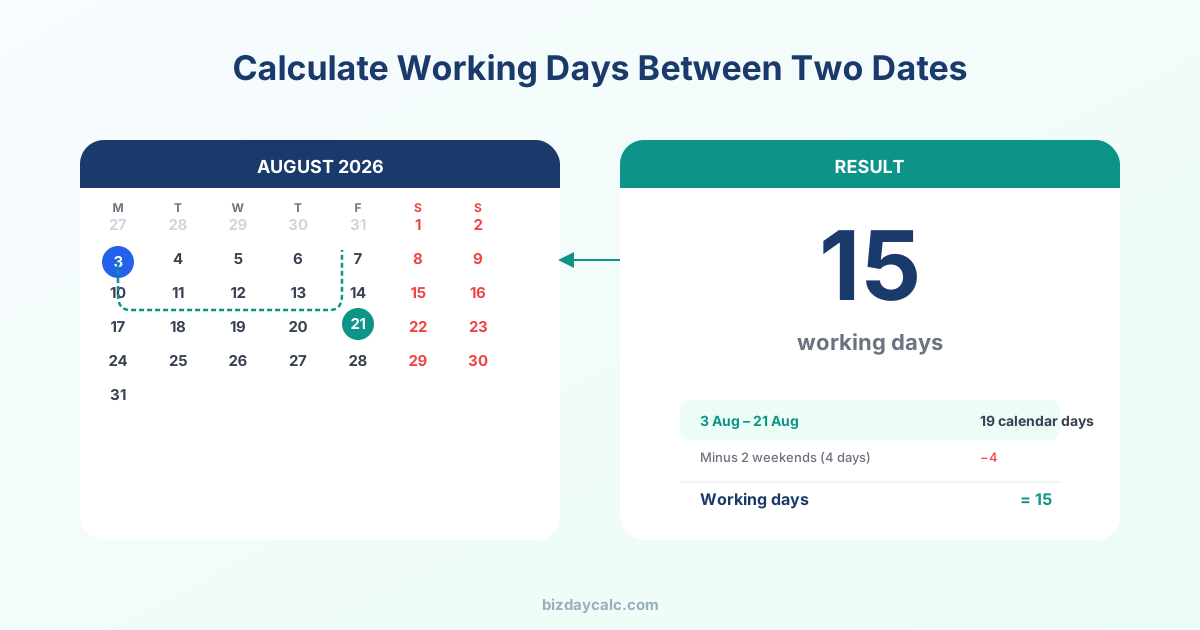
That is why a clear calendar view is useful: it lets you see the dates behind the final number.
Worked example: August 2026
Let’s calculate working days between Monday 3 August 2026 and Friday 28 August 2026, excluding the August Bank Holiday (Monday 31 August is outside our range). Here is the full breakdown:
| Week | Mon | Tue | Wed | Thu | Fri | Working days this week |
|---|---|---|---|---|---|---|
| Week 1 (3–7 Aug) | 3 ✓ | 4 ✓ | 5 ✓ | 6 ✓ | 7 ✓ | 5 |
| Week 2 (10–14 Aug) | 10 ✓ | 11 ✓ | 12 ✓ | 13 ✓ | 14 ✓ | 5 |
| Week 3 (17–21 Aug) | 17 ✓ | 18 ✓ | 19 ✓ | 20 ✓ | 21 ✓ | 5 |
| Week 4 (24–28 Aug) | 24 ✓ | 25 ✓ | 26 ✓ | 27 ✓ | 28 ✓ | 5 |
| Total working days (inclusive of both start and end dates) | 20 | |||||
The August 2026 Bank Holiday falls on Monday 31 August, which is outside our range. If we had extended the range to include 31 August, we would subtract that day, reducing the total to 19 working days for an inclusive count through to 31 August.
If we counted exclusively (excluding the start date), the total would be 19 working days. If we excluded both start and end dates, the total would be 18. This demonstrates why the inclusive/exclusive rule matters: a simple change in interpretation can shift your answer by up to two days.
Formula approach vs calculator approach
There are two main ways to calculate working days between two dates. Each has strengths:
| Method | How it works | Pros | Cons |
|---|---|---|---|
| Excel NETWORKDAYS formula | =NETWORKDAYS(start_date, end_date, [holidays]) | Fast, repeatable, built-in, handles holiday ranges | Requires Excel; easy to mistype dates; holiday list must be maintained |
| Google Sheets NETWORKDAYS | =NETWORKDAYS(start_date, end_date, [holidays]) | Free, cloud-based, same syntax as Excel | Same maintenance burden; locale settings can affect date formats |
| Manual calendar count | Print a calendar; cross off weekends and holidays; count remaining weekdays | No tools needed; forces visual verification | Slow; error-prone; impractical for long date ranges |
| Online calculator (e.g., bizdaycalc) | Enter dates; tool counts automatically and shows a calendar view | Instant; visual output; handles bank holidays automatically; shareable result | Requires internet access; relies on correct country setting |
For one-off checks, a calculator is fastest. For recurring reports or dashboards, build an Excel or Sheets formula with a maintained holiday list.
Edge cases to watch for
Month boundaries
When your date range crosses a month boundary, double-check that you haven’t lost or gained a day. A range from 28 February to 3 March in a non-leap year contains either 2 or 4 calendar days depending on inclusivity, but only 2–3 working days. The short month can trick you.
Bank holiday Mondays
In the UK, most bank holidays fall on Mondays. If your range starts or ends on a Monday, always check whether it’s a bank holiday. A range that looks like it contains 5 working days (Mon–Fri) may only contain 4 if the Monday is a bank holiday.
Christmas and New Year
The Christmas period is the trickiest time of year. With Christmas Day, Boxing Day, and New Year’s Day often creating consecutive non-working days, a range spanning late December to early January can lose 3–5 working days to holidays. Always use a holiday-aware calculator during this period.
Leap years
29 February adds one extra calendar day to the year. If your range includes 29 February and that date falls on a weekday, you gain one extra working day compared to a non-leap year. For payroll calculations that span February, this can matter.
How to verify your results
Before relying on a working-day count:
- Cross-check with a different method. If you used a formula, also do a quick manual count for a sanity check — especially for short ranges where the manual count is quick.
- Print or screenshot the calendar view. Seeing the dates laid out visually often reveals mistakes that numbers alone hide.
- Test the edge of your range. Move the start date forward by one day and the end date back by one day. The result should change predictably. If it doesn’t, something is wrong.
- Check the holiday list. If your result seems off by one or two days, verify that the correct holiday calendar was applied. A UK vs England-and-Wales difference can shift a result.
- Confirm the counting rule. Go back to the source document and re-read whether days are counted inclusively or exclusively. This is the #1 cause of off-by-one errors.
Frequently asked questions
Does NETWORKDAYS include the start date?
Yes. Excel’s NETWORKDAYS formula counts both the start date and the end date inclusively. If you need an exclusive count, subtract 1 (or 2 if excluding both ends).
How many working days are there in a typical UK month?
Most months have 20–23 working days. A month with 31 days that starts on a Monday and has no bank holidays can have 23 working days. February typically has 20 working days (19 in a leap year if the extra day is a weekday).
What if my date range includes a Saturday or Sunday as the start or end date?
If your range starts on a Saturday and you’re counting working days, the count effectively begins on Monday. NETWORKDAYS handles this automatically: it only counts weekdays within the range, regardless of where the range starts or ends.
Useful official resources
These sources are directly relevant to the date, public holiday, delivery, SLA, or complaint-handling topic covered in this article.
Related video searches
If you prefer a video explanation, these searches can help you find relevant explainers on YouTube.
Try the free calculator and review the calendar output before relying on a deadline.
Loading comments...