Quick answer
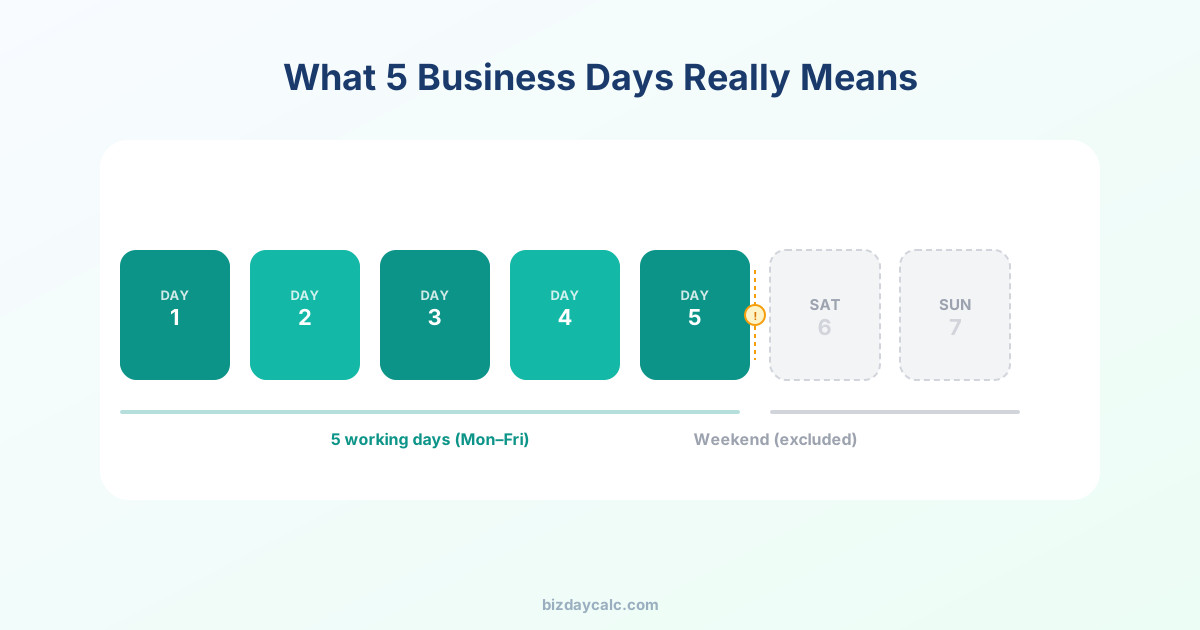
Five business days usually means five working weekdays, normally Monday to Friday. Weekends do not count. Public holidays may also be skipped, so 5 business days can take longer than 5 calendar days.
Key takeaways
- Business days are not the same as calendar days.
- A five-business-day estimate can stretch over a weekend.
- Bank holidays can push the final date out further.
The short answer
Five business days usually means five working weekdays, normally Monday to Friday. Weekends are not counted. Public holidays may also be excluded depending on the company, country, or policy involved.
So if something starts on a Monday, 5 business days may land on the following Monday if the start day is not counted, or Friday if the start day is counted. This is why business day wording often creates confusion.
Example
If a parcel says it will arrive in 5 business days and the clock starts on Tuesday, the weekend normally does not count. That means the expected date may be the following Tuesday, not Sunday.
What can change the answer?
- Whether the first day is included
- Whether the deadline ends at close of business
- Whether bank holidays or public holidays are excluded
- Which country or region the company is using
The easiest way to avoid guessing is to use a calculator that lets you choose dates and exclude holidays where needed.
Real-world examples by industry
Shipping and ecommerce. A customer orders on Thursday afternoon with a "5 business day delivery" estimate. If the courier does not count weekends, the 5 business days run: Friday (day 1), Monday (day 2), Tuesday (day 3), Wednesday (day 4), Thursday (day 5). The parcel arrives the following Thursday — ten calendar days later. If there is a bank holiday on that Friday, add another day.
Customer service SLAs. A support ticket gets logged at 4pm on Wednesday. The team's SLA promises a response within 5 business days. If Friday is a bank holiday, day 1 is Thursday, day 2 is the following Tuesday (Monday is the substitute bank holiday), and day 5 lands on the following Monday. The customer sees an 11-day calendar gap and wonders why.
Invoice follow-ups. You send an invoice on Tuesday and the payment terms say "net 30 business days". Without considering the weekend, 30 business days from a Tuesday is roughly 6 calendar weeks away — but a December invoice will also skip Christmas Day, Boxing Day, and New Year's Day, pushing the due date further into January. Knowing which days do not count helps you plan cash flow more realistically.
5 business days examples
| If the clock starts... | Typical 5th business day | Why |
|---|---|---|
| Monday | Next Monday | Tuesday to Friday count as four days, then Monday is day five. |
| Tuesday | Next Tuesday | The weekend is skipped. |
| Friday | The following Friday | Saturday and Sunday normally do not count. |
If the start day itself is counted, the result can be one working day earlier. That is why some companies say "within 5 business days" while others say "5 business days after" a date.
Is 5 business days a week?
Sometimes, but not always. If the period starts on a Monday and there are no holidays, five business days can fit inside one working week. If it starts later in the week, it usually crosses a weekend.
Related calculators
Useful official resources
These sources are directly relevant to the date, public holiday, delivery, SLA, or complaint-handling topic covered in this article.
Related video searches
If you prefer a video explanation, these searches can help you find relevant explainers on YouTube.
Need to check a date quickly? Try the free business day calculator.
Loading comments...