Quick answer
Complaint deadlines can be measured in working days or calendar days depending on the rule. Check the source policy before relying on any calculated date.
Key takeaways
- Do not mix calendar-day and working-day deadlines.
- Confirm when the clock starts.
- Use a tracker for repeat complaint monitoring.
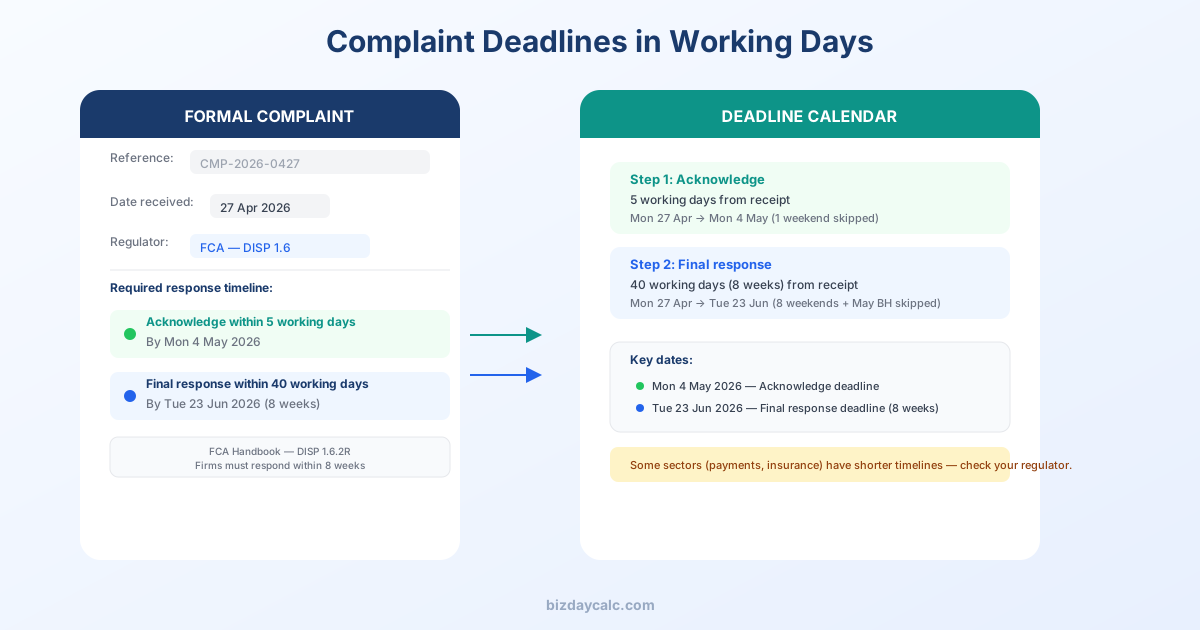
Why working days matter in complaint handling
Complaint processes often use specific time limits. Some are measured in calendar days, while others may use working days. Mixing the two can create deadline errors.
What to check first
- The rule or policy that applies
- Whether the clock starts on receipt or the next working day
- Whether weekends and public holidays are excluded
- Whether the final day ends at close of business
Use calculators carefully
A calculator is useful for checking dates, but formal complaint deadlines should always be verified against the relevant policy, contract, or regulation.
For repeat complaint tracking, a structured deadline tracker may be better than a one-off date calculation.
FCA complaint handling timelines
The Financial Conduct Authority (FCA) sets specific timeframes for complaint handling in its DISP rules. Here’s the key timeline:
| Stage | Deadline | Measured in | Notes |
|---|---|---|---|
| Initial acknowledgement | Promptly | N/A (best practice: within 5 business days) | FCA expects timely confirmation that the complaint was received |
| Final response (standard) | 8 weeks | Calendar weeks from receipt | Most firms must issue a final response within 8 weeks |
| Final response (payment services & e-money) | 15 business days | Business days | Shorter deadline for payment-related complaints; can extend to 35 business days in exceptional circumstances |
| Referral to Financial Ombudsman Service | 6 months | Calendar months from final response | Consumer has 6 months from the date of the final response letter to refer to FOS |
Note the mix: some deadlines are in calendar weeks, others in business days. Applying the wrong counting method to any stage can cause a compliance failure.
Worked example: complaint received Wednesday 5 August 2026
Let’s trace a standard FCA-regulated complaint through the timeline:
| Milestone | Date | How it’s calculated |
|---|---|---|
| Complaint received | Wed 5 Aug 2026 | Day 0 |
| Acknowledgement sent (within 5 business days) | By Tue 11 Aug 2026 | Thu 6, Fri 7, Mon 10, Tue 11 = 4 business days (Mon 10 Aug is not a bank holiday) |
| 8-week final response deadline | Wed 30 Sep 2026 | 8 calendar weeks from 5 Aug = 56 days later |
| FOS referral deadline | Tue 30 Mar 2027 | 6 calendar months from the date of the final response letter |
If the same complaint arrived on Friday 7 August at 4:30pm, the acknowledgement clock effectively starts on Monday 10 August (many firms treat after-hours receipt as next-business-day). The final response deadline, however, is still 8 calendar weeks from 7 August = Friday 2 October 2026, because calendar-week counting does not pause for weekends.
Other regulator timelines compared
Not all complaints follow FCA rules. Here’s how other UK regulators differ:
| Regulator | Applies to | Response deadline | Counting method |
|---|---|---|---|
| FCA (DISP rules) | Financial services firms | 8 weeks (standard); 15 business days (payment services) | Calendar weeks / Business days |
| Financial Ombudsman Service (FOS) | Escalated financial complaints | No statutory response time, but aims to resolve within 90 days | Calendar days |
| Information Commissioner’s Office (ICO) | Data protection complaints | Responds within 14 calendar days (acknowledgement) | Calendar days |
| Ofgem (Energy Ombudsman) | Energy complaints | Supplier must respond within 8 weeks before Ombudsman referral | Calendar weeks |
| Ofcom | Telecoms complaints | Provider must resolve within 8 weeks before ADR referral | Calendar weeks |
| Housing Ombudsman | Social housing complaints | Landlord must respond within 10 working days (stage 1); 20 working days (stage 2) | Working days |
The Housing Ombudsman is particularly strict about the working-day distinction: their Complaint Handling Code explicitly counts in working days, and weekends do not count towards the landlord’s response time.
What happens when a deadline falls on a weekend
This is one of the most practical questions in complaint handling. The answer depends on the counting method:
- Calendar-day or calendar-week deadlines: If the deadline falls on a Saturday or Sunday, some regulators (and many contracts) roll it forward to the next business day. However, this is not universal. The FCA’s 8-week rule, for example, is fixed at 8 weeks — if that date is a Saturday, the deadline remains Saturday. In practice, most firms treat the following Monday as acceptable, but the formal position is that the deadline is not automatically extended.
- Business-day or working-day deadlines: By definition, the deadline cannot fall on a weekend because weekends were never counted in the first place. The deadline will always land on a weekday.
- If the Monday after a weekend deadline is a bank holiday: The deadline rolls to Tuesday. This principle (“the next available business day”) is widely accepted across UK regulatory bodies and is codified in the Civil Procedure Rules for court deadlines.
Frequently asked questions
Does the FCA’s 8-week deadline include the day the complaint was made?
The 8-week period runs from the date the firm receives the complaint. Day 1 is the day after receipt. If a complaint is received on 1 June, the 8-week deadline is 27 July (56 days later). The FCA expects the final response to be issued by the end of that day.
What if I cannot resolve the complaint within 8 weeks?
Under DISP rules, firms must write to the complainant before the 8-week deadline explaining why they cannot issue a final response and when they expect to do so. The letter must also inform the complainant of their right to refer the matter to the Financial Ombudsman Service. This does not extend the deadline; it simply buys time while preserving the consumer’s right to escalate.
Are FOI response deadlines in calendar days or working days?
FOI requests under the Freedom of Information Act 2000 must be answered within 20 working days. The Information Commissioner’s Office (ICO) is clear that “working days” means Monday to Friday excluding bank holidays. A request received on a Friday has a deadline 20 working days later, not 20 calendar days later — a difference of about 8 days.
Useful official resources
These sources are directly relevant to the date, public holiday, delivery, SLA, or complaint-handling topic covered in this article.
Related video searches
If you prefer a video explanation, these searches can help you find relevant explainers on YouTube.
Use the Business Day Calculator for one-off checks, or try the Complaint Deadline Tracker for repeat workflows.
Loading comments...